Sagar Pandya on Why AI Adoption Fails — And How Culture Is the Missing Piece
Mar 17, 2026
Artificial intelligence has rapidly become one of the most significant investments modern organizations are making. Companies across industries are pouring millions into AI tools, platforms, and infrastructure with the expectation that these technologies will unlock productivity, insight, and competitive advantage. Yet despite this wave of investment, many AI initiatives quietly stall or fail to deliver meaningful results.
According to consultant and exited founder Sagar Pandya, the problem is rarely the technology itself. The real obstacle, he argues, is culture.
Pandya, a serial entrepreneur and AI strategist with more than two decades of experience in IT, cybersecurity, and digital transformation, has spent much of his career observing the disconnect between technical potential and organizational reality.
As the founder of The AI Culture Company and previously the leader of a 50-person AI consulting organization following an acquisition, he has seen firsthand how businesses can deploy sophisticated AI systems but struggle to achieve genuine adoption among employees and leadership teams.
From Pandya’s perspective, organizations often assume that AI transformation is a purely technical challenge. Leaders focus on selecting the right tools, hiring engineers, and integrating systems. But according to Pandya, this approach overlooks the most complex factor in any transformation: human behavior.
In many companies, employees quietly resist AI initiatives due to fear of job displacement, uncertainty about their role in an AI-enabled workplace, or a lack of trust in leadership’s strategy.
This dynamic creates what Pandya describes as the “AI culture lag,” a widening gap between rapidly evolving technology and the slower pace at which organizations adapt culturally. Companies adopt powerful AI tools, but their teams remain unprepared for the identity shifts and workflow changes those tools introduce. The result is predictable: expensive systems sit underused while executives wonder why their investments are not translating into measurable impact.
Pandya’s work focuses on closing this gap. Through his consulting firm, The AI Culture Company, he advises founders, executives, and leadership teams on building what he calls an “AI-ready culture.” Rather than treating AI as a software rollout, he encourages organizations to approach it as a people-first transformation that requires trust, communication, and leadership alignment.
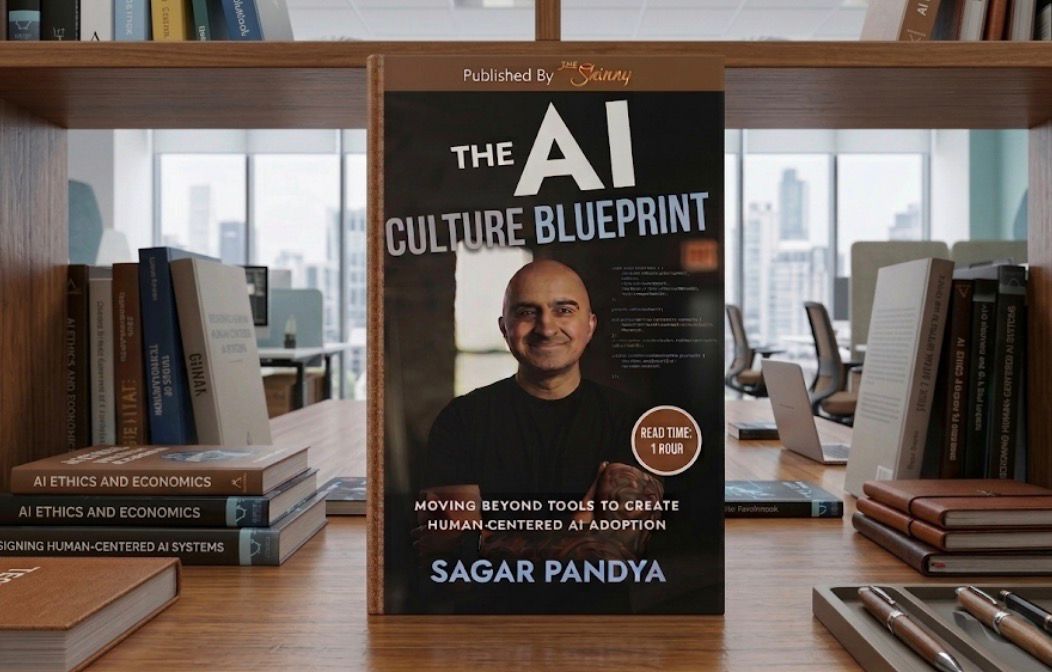
This philosophy forms the foundation of his book, The AI Culture Blueprint, which outlines a practical leadership framework for human-centered AI adoption. The book argues that successful AI transformation is less about algorithms and more about organizational psychology. When leaders underestimate the emotional and cultural impact of AI, resistance inevitably emerges beneath the surface of the organization.
Pandya addresses this challenge through what he calls the “5C framework”: Commit, Communicate, Co-Create, Coach, and Cultivate. Each element reflects a step in building sustainable AI adoption inside organizations.
Commit refers to leadership alignment. AI initiatives require visible commitment from senior leaders who clearly articulate why AI matters for the organization’s future. Without this alignment, employees often perceive AI projects as temporary experiments rather than meaningful strategic shifts.
Communicate focuses on transparency. Employees must understand how AI will affect their roles and what new opportunities may emerge. When communication is vague or inconsistent, fear fills the gap.
Co-Create emphasizes involving teams directly in the transformation process. Instead of imposing AI solutions from the top down, Pandya advocates engaging employees in shaping how AI integrates into their workflows.
Coach addresses the need for education and skill development. Organizations cannot expect employees to embrace AI if they lack the training and confidence to work alongside these tools effectively.
Finally, Cultivate represents the long-term effort required to sustain an AI-ready culture. Transformation is not a one-time project but an ongoing process of learning, adaptation, and leadership reinforcement.
Pandya’s perspective resonates with many executives who are now confronting the limitations of purely technical AI strategies. While the industry often emphasizes model performance and platform capabilities, Pandya argues that the organizations that truly succeed with AI will be those that master the human side of change.
His career has given him a unique vantage point on this issue. With more than twenty years spent working across enterprise technology environments, and experience leading a large AI consulting organization after an acquisition, Pandya understands both the technical and operational realities of large-scale AI implementation. This blend of technical credibility and cultural insight allows him to speak to both executives and frontline teams navigating the complexities of AI transformation.
As artificial intelligence continues reshaping industries, the conversation around adoption is evolving. Companies are beginning to recognize that technology alone cannot drive transformation. Instead, success depends on whether leaders can align their organizations around a shared vision for how AI will augment human work.
For Pandya, the path forward is clear. AI adoption strategy must move beyond tools and infrastructure toward human-centered leadership. Organizations that focus solely on software may continue to struggle with stalled initiatives. But those willing to invest in culture, trust, and communication may find that AI’s true power lies not just in algorithms, but in the people who choose to embrace them.
More about Sagar Pandya and his work on human-centered AI adoption can be found through his professional insights on LinkedIn and in his book The AI Culture Blueprint, which explores how leaders can close the gap between fast-moving technology and the teams responsible for bringing it to life.
Related Post



Latest Post
Shovon Ahmed
Aug 22, 2026
Shovon Ahmed
Aug 12, 2026

Martinez grev
Jul 27, 2026

Martinez Grev
Jun 3, 2026